What's the minimum budget to study in Thailand? |
|
There are many foreign students in Thailand who could not afford to study in their own country. From them, we draw a surprising experience: As smaller your budget, as more you will learn to live in a foreign culture since you will learn to live as the Thais do.
âWhen in Rome, do it as the Romans doâ is an saying in the western world. Since Bangkok is an international metropolis, you find any kind of luxury from your daily food and beverages to designer apartments on the 33rd floor of a high riser looking over Bangkok. Certainly, you can spend as much money as you have in Thailand, you wonât ever have a problem to get rid of it.
Here, we forget about what we call in Thailand âfarang pricesâ (âfarangâ is the term used for western foreigners) and focus on the minimum budget to live a decent student life. If you know about the traps, and follow some simple rules, you can live in Thailand for a surprisingly small budget.
To make differences and limitations more clear, we will name all prices in Thai Baht. For currency conversion, you may want to use .
To understand how that comes, it is first necessary to forget about income and price structure in your own country. Income distribution in Thailand is very different between Bangkok and rural areas. The teenagers working at McDonalds in Bangkok would make between 18 and 22 Baht per hour (that means half a dayâs salary for a Big Mac). Â An average waiter in Pattaya, another big city, will make about 10 to 15 Baht per hour. In Isaan, you get workers aged around 20 for 7 to 10 Baht (all that in 2008).
 As it is everywhere, prices go hand in hand with income. Income in Bangkok is higher, and so are the prices. Since most of you will study in Bangkok, we will focus on the costs in this metropolis. A simple dish, such as Fried Rice with Chicken, is currently about 30 Baht. With a bottle of Coke, you pay 40 Baht. This would not be enough to buy a single litre of premium petrol, however. By the way, this Fried Rice with Chicken is a real As it is everywhere, prices go hand in hand with income. Income in Bangkok is higher, and so are the prices. Since most of you will study in Bangkok, we will focus on the costs in this metropolis. A simple dish, such as Fried Rice with Chicken, is currently about 30 Baht. With a bottle of Coke, you pay 40 Baht. This would not be enough to buy a single litre of premium petrol, however. By the way, this Fried Rice with Chicken is a real
meal for 30 Baht, while one Cheeseburger at McDonalds costs the same.
Relationships between different categories of goods are different than they might be in your country. Next,
you see an overview of average salaries in different jobs. Although a few years old, you may well assume
that income didnât grow much until today.
|
Employment Description or Position
|
Salary in THB (Thai Baht)
|
| Fishing |
2,968 |
| Agriculture, hunting and forestry |
3,019 |
| Private households with employed persons |
4,068 |
| Construction |
4,706 |
| Hotels and restaurants |
5,680 |
| Other community and social work |
6,311 |
| Manufacturing |
6,420 |
| Wholesale and retail trade, repair business |
6,760 |
| Mining and quarrying |
7,646 |
| Real estate, renting and business activities |
9,571 |
| Health and social work |
10,804 |
| Public administration and defense |
11,375 |
| Transport, storage and communication |
11,752 |
| Education |
14,883 |
| Electricity, gas and water supply |
17,841 |
| Financial intermediation |
19,325 |
(National statistics 2005, taken from: )
With such little income, cost of living must be cheap either. Thatâs not necessarily true for a foreigner as well, however, for two reasons. First, since everybody thinks you have a lot of money as a foreigner, thereâs a clear tendency to charge you simply more for the same things. Secondly, Thais certainly learned over time that foreigners tend to go to places that seem to be a bit like in their own country, such as a restaurant looking like a western restaurant, or in Bangkok, just to Khaosan Road.
A small portion of Spaghetti will cost you well over 100 Baht, and a pizza with one glass of western beer quickly comes to 500 Baht. A small bottle of Warsteiner or Guiness is usually between 150 and 200 Baht, while the tasty Thai beer âChangâ costs about 40 Baht for a big bottle (0.64 litre) in a 7-Eleven shop (and 'Chang' is clearly stronger than western beers, meaning you need less :-).
 If you are willing to live like a Thai, you wonât need a big budget. If you insist on behaving like a tourist, you will need the same budget as you would need at home (200 Baht for a small bottle of western beer is about 5 USD or 4 ⬠- thatâs not what one would call âcheapâ). At home, you don't visit an expensive Thai restaurant every day. Watch the reverse picture: In Thailand, western food is as expensive as Thai food is in your country. The best rule is 'go where the students go'. If you are willing to live like a Thai, you wonât need a big budget. If you insist on behaving like a tourist, you will need the same budget as you would need at home (200 Baht for a small bottle of western beer is about 5 USD or 4 ⬠- thatâs not what one would call âcheapâ). At home, you don't visit an expensive Thai restaurant every day. Watch the reverse picture: In Thailand, western food is as expensive as Thai food is in your country. The best rule is 'go where the students go'.
To enable you to determine your own budget, we will now have a look at the cost of study (tuition fees), and then on the cost of living.
Cost of study (tuition fees)
For undergraduate studies, we prepared an overview of average program costs for you. There are some things you should know, however.
First, not all universities spread the tuition fees equally over the semesters. Some universities charge you with more during the first semesters, while tuition fee is lower in the last semesters.
Some programs are more expensive since heavy technology is needed, such as laboratories in applied chemistry or nanotechnology. If you compare standard programs, such as business administration, you may be surprised about the range of tuition fees. Generally, higher tuition fees donât necessarily mean better education. Demand for international programs in Thailand is high due to the inflation of academic degrees over time. Thereâs almost no white collar job to get anymore without a bachelor degree. With about half a million graduates leaving Thai universities per year, international programs became an alternative for getting a better starting position.
Since everybody in Thailand knows that international programs are more costly then standard programs in Thai, many say that some universities just cash in on that. Even for a high tuition fee, the only international element in such a program might be a US college textbook.
The most important single factor of good university education is the quality of the professors. When looking a bit deeper into the different tuition fees, you will quickly find out that some of the cheapest programs offer you 90% coverage of all courses by western university professors, while some of the most expensive programs are not worth their money at all.
 Be aware of hidden costs! An important cost factor might be the additional payments, such as for textbooks. You will want to make sure that you calculate such expenditure as well. Again, in some of the cheapest programs, all textbooks, handouts, academic and administrative fees are included, while in some of the most expensive programs, you need additional budget to cover these hidden costs. Not all universities are eager to publish the real cost of study in order to look a bit better against competition. Be aware of hidden costs! An important cost factor might be the additional payments, such as for textbooks. You will want to make sure that you calculate such expenditure as well. Again, in some of the cheapest programs, all textbooks, handouts, academic and administrative fees are included, while in some of the most expensive programs, you need additional budget to cover these hidden costs. Not all universities are eager to publish the real cost of study in order to look a bit better against competition.
Finally, there are rankings on the Internet of âname universitiesâ against âno-name universitiesâ in Thailand. Name universities exist in every country; they are more attractive and promise better job opportunities after graduation.
Please be aware that this applies only within Thai society, however. There is no reason to believe that a name
university offers a better international program than a no-name university does. Check the credentials of the
professors, and donât get lured by a stylish campus or pictures of beautiful girls (actually, they are all beautiful, on
every campus).
Cost of living
The vast majority of all Thai students in Bangkok live in a one room apartment with their own bathroom. While Thai students love to share their rooms (Thais hate to do anything alone), you probably will prefer to have a âsafe havenâ on your own. A 30-40 square meter apartment you will get in a modern and well-maintained building for around 4,000 Baht a month (see How to find an apartment). With wireless ADSL (very widespread), water, and power supply, it may sum up to 5,500 Baht per month â if you get adjusted to using a fan instead of air condition. Heavy use of air condition can easily double your monthly expenditure since power consumption was sure not an argument when purchasing your roomâs air-con.
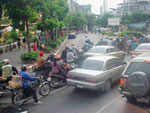 You may want to make sure that your apartment is close to the campus. Compared to the cost of a dinner, taxis are You may want to make sure that your apartment is close to the campus. Compared to the cost of a dinner, taxis are
very expensive and usually stick (with their meter running, of course) in the same traffic jam as a bus does. The most expensive busses are the air-conditioned ones. Even with currently rising prices, you wonât need to pay more than 10
or 15 Baht for a ride. By the way, riding by tuk-tuk may still appear nice to you, but between all the busses with their
black dust, and with you as a foreigner being the target of all sorts of scams and excessive prices, you won't do that often.
By the way, donât dream about buying a cheap bicycle for the way to the campus until you know Bangkok traffic and climateâ¦
If you donât want to spend the money for a health insurance, visiting a doctor is as cheap as medicine is. There are hospitals targeting westerners, of course. Getting a tooth extracted and a denture over two teeth made, for example, may cost about 25,000 Baht in such a hospital. For that price, you can expect nurses and doctors to speak English fluently.
In the âland of smilesâ, however, good looking teeth are of highest importance for everybody. If you go with a Thai fellow student as a translators into a Thai hospital (equally modern as the western oriented one), the extraction will cost you about 200 Baht, and the denture comes for about 2,500 Baht.
 In Thailand, many things are different when it comes to expected cost structures. With the low salaries listed above, many Thai people make a very decent living. To run on budget just needs you to learn how they do it. This learning In Thailand, many things are different when it comes to expected cost structures. With the low salaries listed above, many Thai people make a very decent living. To run on budget just needs you to learn how they do it. This learning
effect causes a lot of what we call âliving experiences in a foreign cultureâ.
There are numerous other fields where westerners spent unnecessarily much money. Some are obvious, some you need to see in reality to understand. Unfortunately, we canât mention them all here. However, we think you've got a
good idea about expenditure in Thailand already.
When international students made the photo stories about foreign students in Bangkok, they also asked them for their monthly over-all expenses. Most of them have budgets ranging between 10,000 and 20,000 Baht per month, still allowing them for the evening beer, apparel, hobbies, and cigarettes.
 Let us finish this article with a word about travelling in Thailand. Sure you know the cost of a holiday in one of the most developed tourist destinations in Thailand already. When youâre here, try something else: Accept the offers of your
Thai fellow students to join them for a trip to the beach. They travel a lot, and they know to reach the most beautiful places Let us finish this article with a word about travelling in Thailand. Sure you know the cost of a holiday in one of the most developed tourist destinations in Thailand already. When youâre here, try something else: Accept the offers of your
Thai fellow students to join them for a trip to the beach. They travel a lot, and they know to reach the most beautiful places
on budget. A weekend at the beach with a lot of fun may cost you well below 1,500 Baht including transportation.
You see, there are a lot of reasons âto do it as the Romans doâ!
Back to articles
|



